
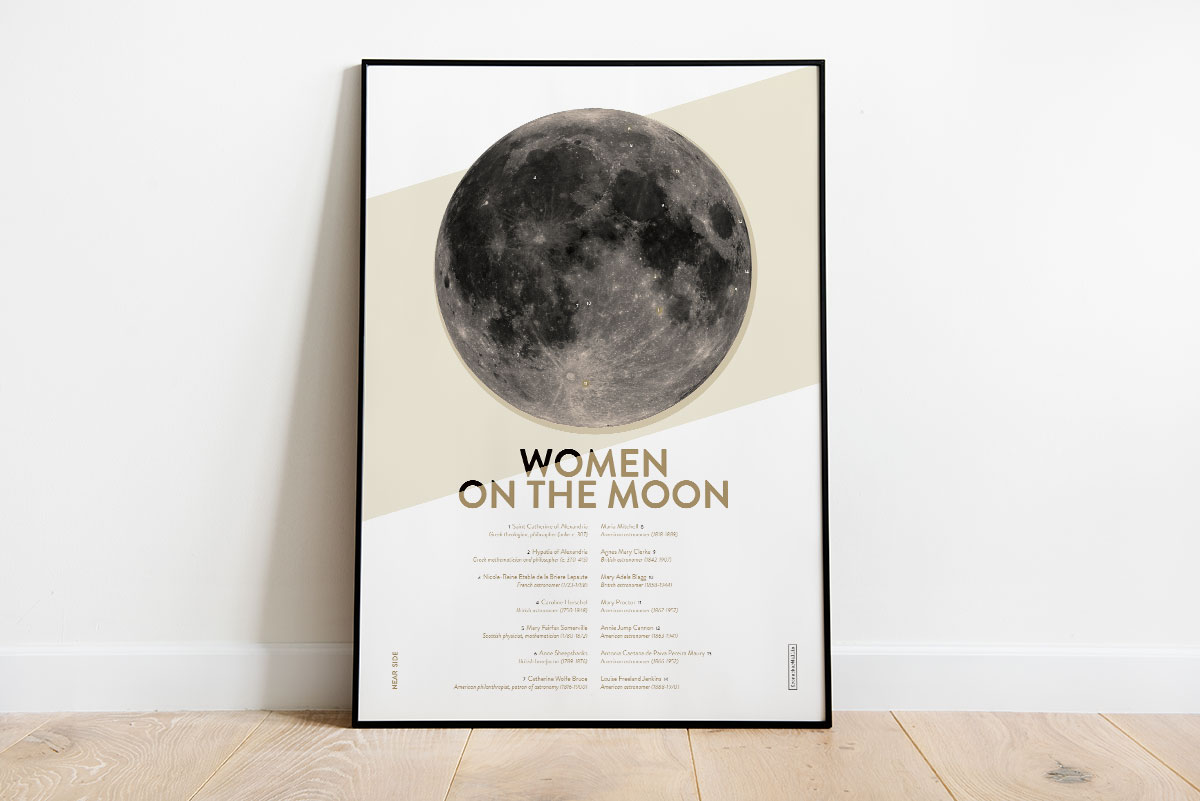

Women on the moon posters
35€
In stock
Description
A Map of Overlooked Genius
The Moon's surface contains over 9,000 named features—craters, valleys, mountains, and maria. Yet fewer than 1% honor women's contributions to science, mathematics, and space exploration. This poster set serves as both celestial atlas and historical documentation, revealing where these rare acknowledgments exist and celebrating the extraordinary women whose names reached the lunar surface.
Each poster maps one hemisphere of the Moon, showing the exact locations of craters and features named after female scientists, mathematicians, astronomers, and space pioneers. Together, they form a complete visual record of women's representation in lunar nomenclature—a powerful statement about both achievement and historical underrepresentation.
Who Are the Women on the Moon?
From ancient philosophers to modern astronauts, from Nobel laureates to hidden figures whose work enabled space exploration, these 31 women represent diverse fields and eras:
- Ancient scholars: Hypatia of Alexandria, Catherine of Alexandria
- Pioneering astronomers: Caroline Herschel, Maria Mitchell, Henrietta Swan Leavitt
- Nobel Prize winners: Marie Curie (Skłodowska), Gerty Cori
- Mathematical geniuses: Emmy Noether, Sofia Kovalevskaya
- Space age heroes: Valentina Tereshkova (first woman in space)
- Fallen astronauts: The Challenger and Columbia crews
- Hidden figures: Dorothy Vaughan and the women who calculated trajectories
Their contributions span mathematics, astronomy, physics, chemistry, space exploration, and more—fields where women often worked without recognition, credit, or equal opportunity.
Educational and Inspirational
These posters serve multiple purposes:
- STEM education: Teaching students about women's scientific contributions
- Historical documentation: Visualizing gender disparity in scientific recognition
- Inspiration: Showing young scientists that women belong in space exploration
- Conversation starter: Prompting discussions about representation and recognition
- Beautiful cartography: Elegant lunar maps worthy of display
Perfect for STEM classrooms, women in science organizations, university departments, museums, libraries, and homes celebrating scientific achievement and gender equality in STEM fields.
Complete List: Every Woman on the Moon
Only a few women have their names on the moon. Who are they? and where are these names?
Near side of the Moon (14 names):
- Catherine of Alexandria - Greek theologian, philosopher
- Hypatia of Alexandria - Greek mathematician and philosopher
- Nicole-Reine Etable de la Briere Lepaute - French astronomer
- Caroline Herschel - British astronomer
- Mary Fairfax Somerville - Scottish physicist, mathematician
- Anne Sheepshanks - British benefactor
- Catherine Wolfe Bruce - American philanthropist, astronomy patron
- Maria Mitchell - American astronomer
- Agnes Mary Clerke - British astronomer
- Mary Adela Blagg - British astronomer
- Mary Proctor - American astronomer
- Annie Jump Cannon - American astronomer
- Antonia Caetana de Paiva Pereira Maury - American astronomer
- Louise Freeland Jenkins - American astronomer
Far side of the Moon (17 names):
- Sofia V. Kovalevskaya - Russian mathematician
- Williamina Paton - Scottish-born American astronomer
- Marie Skłodowska - Polish physicist, chemist, Nobel laureate
- Annie de Scott Dill Russell - British astronomer
- Henrietta Swan Leavitt - American astronomer
- Lise Meitner - Austrian physicist
- Emmy Noether - German mathematician
- Priscilla Fairfield Bok - American astronomer
- Gerty Theresa Radnitz Cori - Czech-American physiologist; Nobel laureate
- Dorothy Vaughan - American mathematician
- Marie Tharp - Geologist and oceanographer
- Valentina Tereshkova - Soviet cosmonaut
- Sharon Christa Corrigan - School teacher member of the Challenger crew
- Judith Arlene Resnik - Member of the Challenger crew
- Kalpana Chawla - American astronaut, Space Shuttle Columbia Mission Specialist
- Laurel Clark - American astronaut, Space Shuttle Columbia Mission Specialist
- Elisabetta Pierazzo - Italian planetary scientist
Why So Few Women on the Moon?
The International Astronomical Union (IAU) establishes naming conventions for celestial features. Lunar craters are typically named after deceased scientists, explorers, and scholars who made outstanding contributions. The dramatic underrepresentation of women reflects historical barriers that prevented women from accessing education, publishing research, receiving credit for discoveries, or being recognized by scientific institutions.
Many brilliant women scientists worked as "human computers," uncredited collaborators, or under male colleagues' names. Their contributions were essential but often invisible. Even Marie Curie—the only person to win Nobel Prizes in two different sciences—initially was nearly excluded from her first Nobel Prize until advocates insisted on her inclusion.
These posters honor the few who achieved recognition while implicitly acknowledging the countless unnamed women whose contributions remain uncelebrated.
Notable Women Featured
Hypatia of Alexandria (c. 360-415 CE): Ancient mathematician, astronomer, and philosopher who taught at the famous Library of Alexandria. Her tragic murder marked a turning point in classical scholarship. Explore her story further with our Hypatia portrait poster.
Caroline Herschel (1750-1848): The first woman to discover a comet and the first woman to receive a salary as a scientist, working alongside her brother William in revolutionary astronomical observations.
Marie Skłodowska Curie (1867-1934): Two-time Nobel laureate whose research on radioactivity transformed physics and chemistry. Despite winning a Nobel Prize in Physics (1903) and Chemistry (1911), she faced persistent gender discrimination. Read her groundbreaking research in Marie Curie's doctoral thesis.
Emmy Noether (1882-1935): German mathematician whose theorem connecting symmetry and conservation laws is considered one of the most important mathematical theorems in physics. Albert Einstein called her "the most significant creative mathematical genius thus far produced since the higher education of women began."
Henrietta Swan Leavitt (1868-1921): American astronomer whose discovery of the period-luminosity relationship for Cepheid variables enabled astronomers to measure cosmic distances—work that led to understanding the universe's expansion.
Dorothy Vaughan (1910-2008): NASA mathematician featured in "Hidden Figures," who led the West Area Computing unit and became NASA's first Black supervisor, calculating trajectories for Mercury and Apollo missions.
Valentina Tereshkova (b. 1937): Soviet cosmonaut who became the first woman in space aboard Vostok 6 in 1963—a record-breaking achievement that predated the first American woman in space by 20 years.
A Powerful Statement Piece
These posters make a statement about representation, recognition, and the ongoing struggle for equity in STEM fields. They're equally at home in:
- University women's studies and STEM departments
- Science museums and exhibitions on gender equality
- K-12 classrooms teaching science history
- Corporate offices promoting diversity in STEM
- Libraries and educational institutions
- Homes celebrating scientific achievement and women's history
Product Details
2 posters. Not sold separately.
Specifications:
- Quantity: 2 posters (near side and far side of the Moon)
- Size: A2 (420 × 594 mm / 16.5 × 23.4 inches) each
- Unframed, ready for custom framing
- Quality printing
- Shows all 31 lunar features named after women
Explore More Women in Science
Continue celebrating women's scientific contributions with related products from Kronecker Wallis:
- Hypatia Poster - Hand-drawn portrait of the ancient mathematician with her inspiring quote
- Marie Curie's Thesis - Her groundbreaking doctoral research on radioactive substances
- Portraying Science - 400+ page book featuring portraits of prominent scientists including women pioneers
Perfect For
- STEM educators teaching women's contributions to science
- Women in science organizations celebrating pioneers
- University departments promoting diversity and inclusion
- Space enthusiasts interested in lunar cartography and nomenclature
- Gift-givers honoring female scientists, students, and professionals
- Museums and libraries with women's history or science collections
- Parents and educators inspiring young women in STEM








 No products in the cart.