
Marie Curie’s Thesis – Bilingual Edition
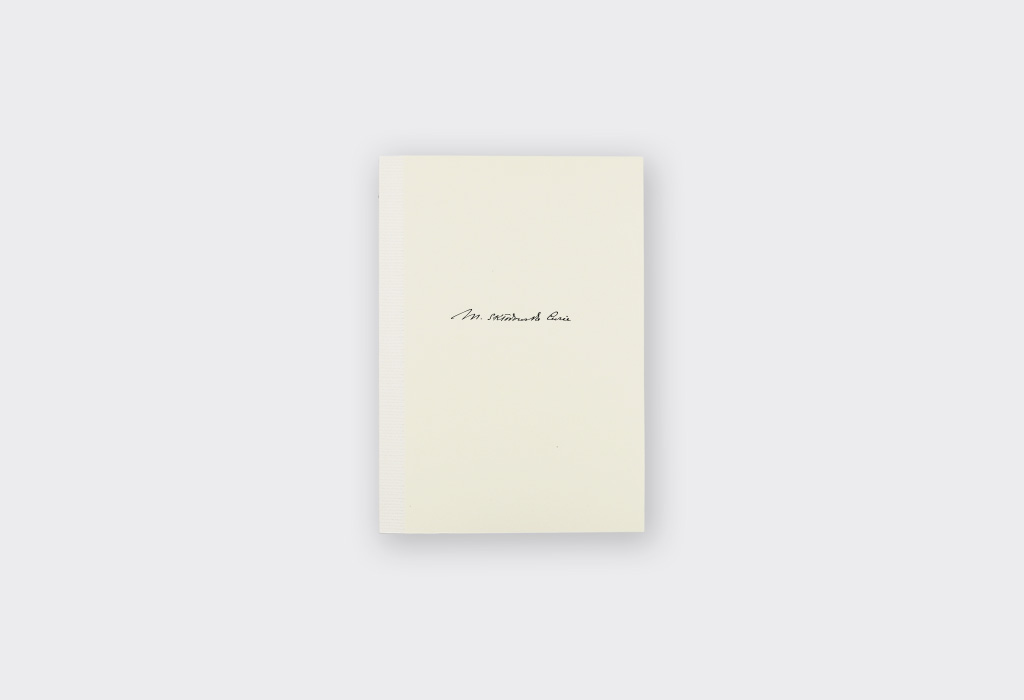
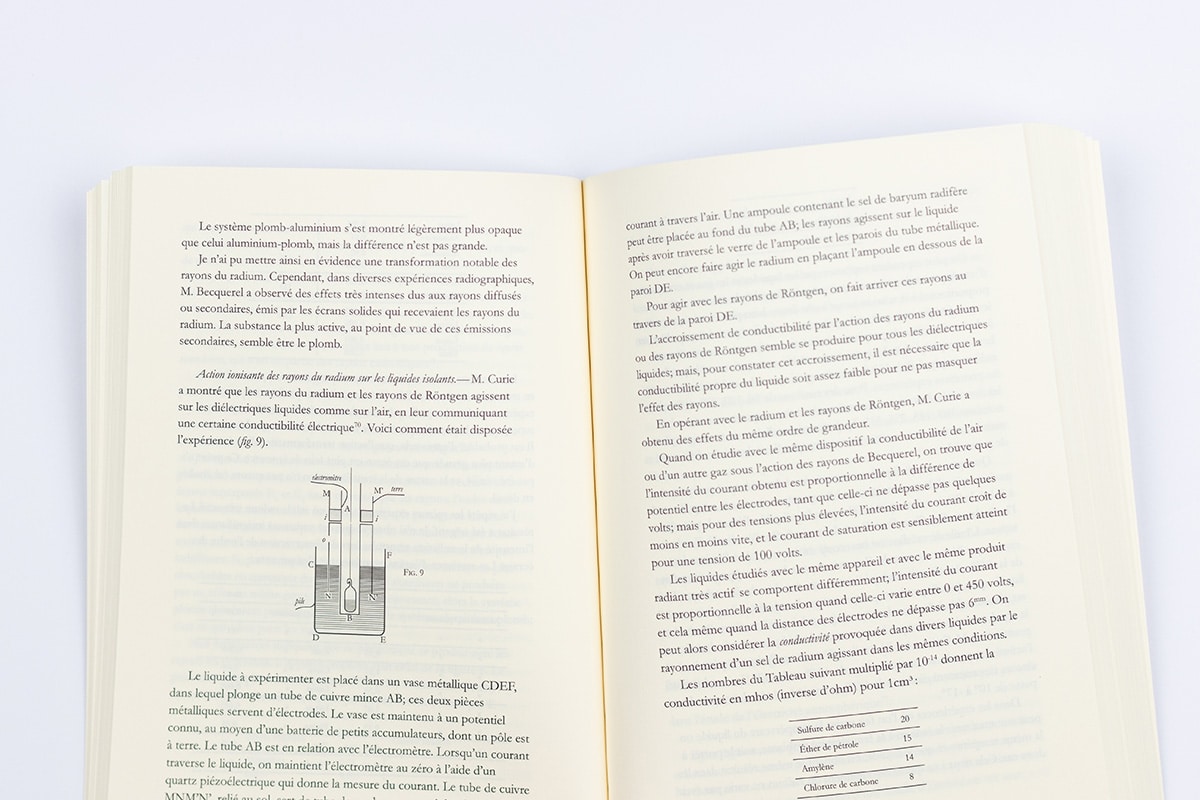
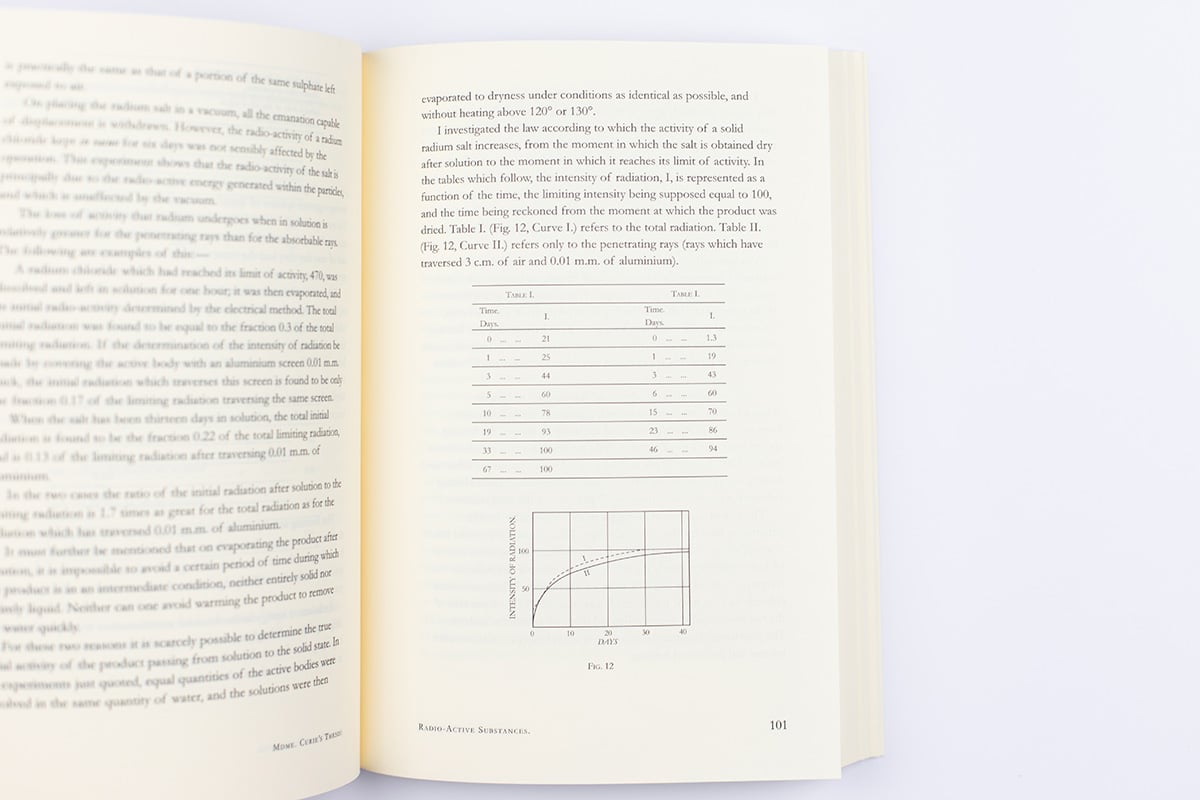
The doctoral thesis that earned Marie Curie the Nobel Prize. This bilingual edition presents Curie’s groundbreaking 1903 research “Recherches sur les substances radioactives” in the original French alongside the complete English translation, in an elegant dual-sided A5 format.
40€
In stock
Description
The Research That Discovered Radioactivity's Secrets
On June 25, 1903, Marie Sklodowska Curie defended her doctoral thesis at the University of Paris Sorbonne. The examining committee, including renowned physicists Gabriel Lippmann, Edouard Bouty, and Henri Moissan, awarded her the highest distinction. Five months later, she became the first woman to receive the Nobel Prize in Physics.
This is that thesis. The document where Marie Curie presented her systematic investigation of radioactive substances, announced the discovery of two new elements (polonium and radium), and laid the foundations of nuclear physics.
Revolutionary Discoveries Within These Pages
Marie Curie's thesis documents some of the most important scientific discoveries of the 20th century:
- Systematic study of uranium rays and the coining of the term "radioactivity"
- Discovery of polonium (named after her native Poland, then under foreign occupation) in 1898
- Discovery of radium, an element 900 times more radioactive than uranium
- Isolation of pure radium: years of painstaking work processing eight tons of pitchblende residue in a converted shed without proper ventilation, often in extreme heat or cold
- Measurement techniques for detecting and quantifying radiation
- Evidence that radioactivity is an atomic property, not a chemical one
Bilingual Edition With Innovative Design
- Two languages, one book: The original French text ("Recherches sur les substances radioactives") begins from one side; flip the book and the English translation (from Chemical News, 1904) begins from the other
- Dual-sided format: Each language has its own "front cover," meeting in the middle
- Elegant typography: Clean design that honors the precision of Curie's scientific writing
- Premium materials: Quality paper and binding in compact A5 format
The Only Person to Win Nobel Prizes in Two Sciences
This thesis launched a career of unparalleled achievement. In 1911, Curie won a second Nobel Prize, this time in Chemistry, for isolating pure radium and determining its atomic weight. She remains the only person in history to receive Nobel Prizes in two different sciences.
Yet Marie Curie faced persistent discrimination throughout her career. She was initially nearly excluded from her first Nobel Prize until advocates insisted on her inclusion. The French Academy of Sciences rejected her membership in 1911 by two votes.
During World War I, she developed mobile radiography units ("petites Curies") to provide X-ray services to field hospitals, personally driving to the front lines and training operators. Marie Curie died in 1934 from aplastic anemia, likely caused by prolonged radiation exposure. Her laboratory notebooks remain too radioactive to handle without protection.
Who Should Own This Book
- Students and researchers in physics, chemistry, and nuclear science
- Women in STEM looking for inspiration from history's greatest female scientist
- French language students interested in scientific French
- History of science collectors and academic libraries
- Gift buyers seeking meaningful presents for scientists, teachers, and curious minds
Explore More Women in Science
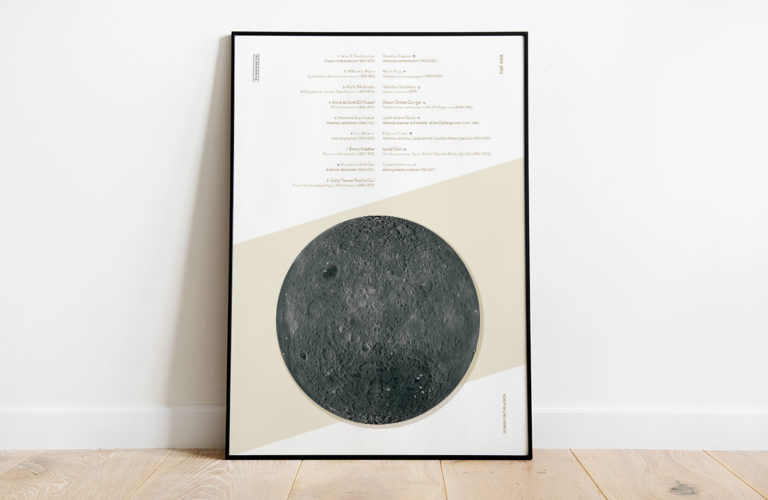
- Women on the Moon Posters - Mapping all 31 lunar features named after women, including Marie Sklodowska's crater
- Hypatia Poster - Celebrating the ancient mathematician and philosopher
- Portraying Science - 400+ page book featuring portraits of prominent scientists
Frequently Asked Questions
What languages is this book in?
This is a bilingual edition containing both the original French text ("Recherches sur les substances radioactives") and the complete English translation published in Chemical News in 1904. Each language begins from opposite sides of the book.
Is this the complete doctoral thesis?
Yes. This edition contains Marie Curie's complete 1903 doctoral thesis as defended at the University of Paris Sorbonne, including all experimental data, measurements, and findings on radioactive substances.
Do I need to know French to read this book?
No. The English translation is complete and self-contained. The French original is included for scholars, French-language students, or anyone who wants to read Curie's words in the language she wrote them.
Is this a good gift for women in science?
Yes. Marie Curie was the first woman to win a Nobel Prize and remains the only person to win Nobel Prizes in two different sciences. Her thesis is a powerful symbol of scientific achievement and perseverance, making it a meaningful gift for women in STEM, students, or anyone inspired by her legacy.
Specifications
- Format: A5 (148 x 210 mm / 5.8 x 8.3 inches)
- Languages: French (original) and English (1904 translation)
- Design: Dual-sided bilingual format
- Content: Complete doctoral thesis with all data and findings
- Publisher: Kronecker Wallis, Barcelona
"Nothing in life is to be feared, it is only to be understood. Now is the time to understand more, so that we may fear less." - Marie Curie



 No products in the cart.